Roof leak repair in Los Angeles, traced to the source, any hour
A stain on the ceiling rarely sits under the hole in the roof. We answer around the clock, stop the water first, then trace the leak along the deck to its real source and fix that, so you pay for the repair once.
- Answered 24/7
- Leak tracing
- Temporary cover first
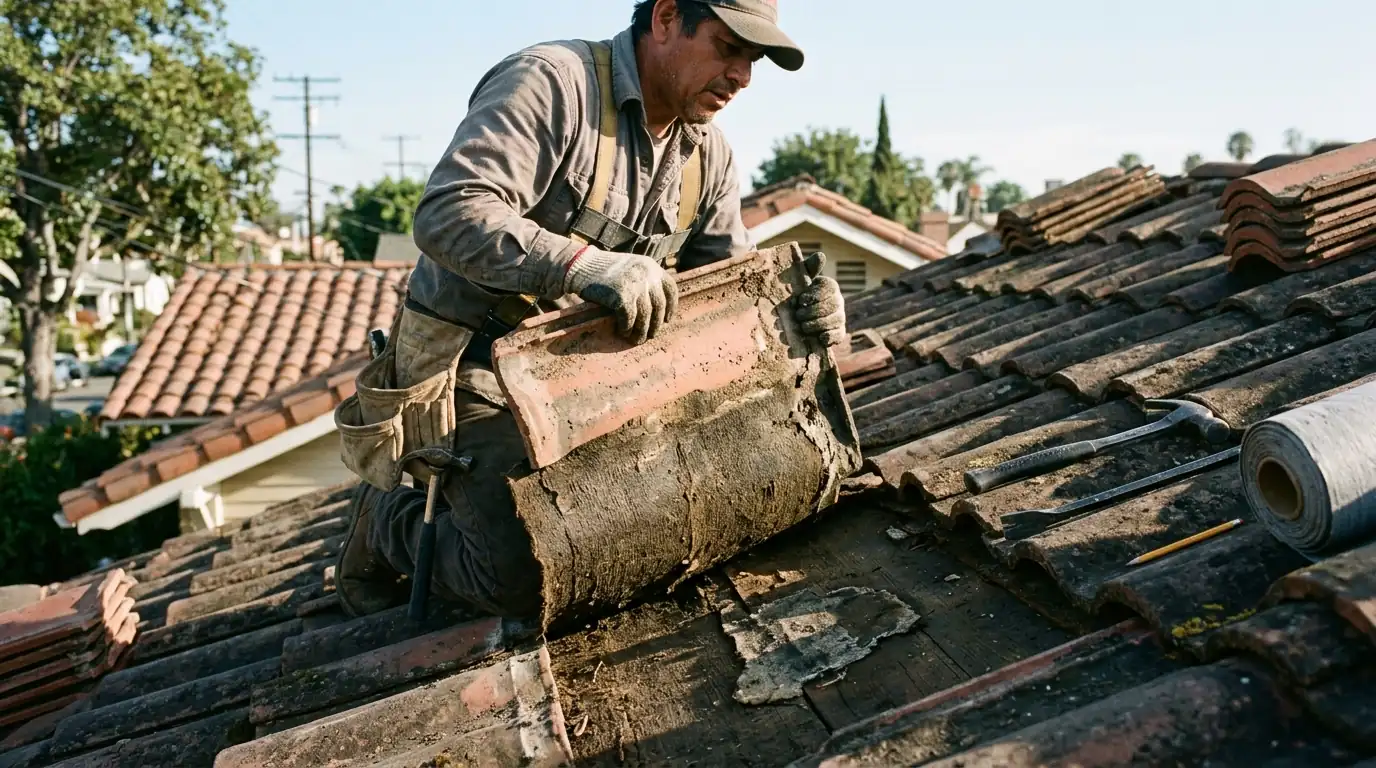
Roof leak repair in Los Angeles starts with tracing: water enters at one point and travels along battens, deck and rafters before it drips, so the stain is often feet from the opening. We answer 24/7, cover the roof if water is coming in, find the true source and repair that spot permanently.
Updated September 2026
The drip is the end of the path, not the start
Roofs usually leak at transitions: valleys, pipe boots, vents, skylights, chimneys and walls. From there, water runs downhill on the deck or along a rafter until it finds a nail, a seam or a low point in the ceiling. That is why patching the roof directly above a stain so often misses.
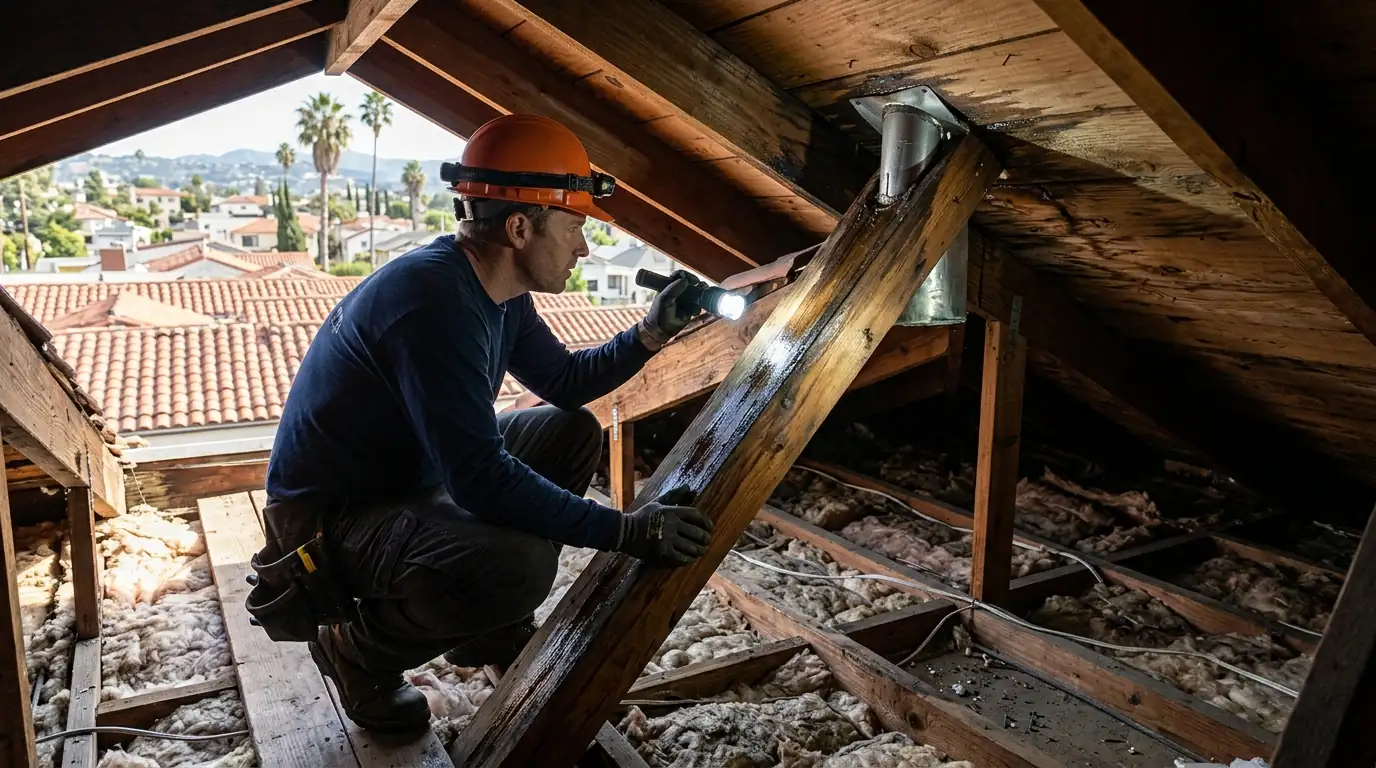
We trace from both sides. In the attic we follow stains and damp wood uphill; on the roof we check every transition above that path. If the drip is condensation or a plumbing vent, we say so. For the first hour, see what to do right after a roof leak starts.
Signs of a roof leak to catch early
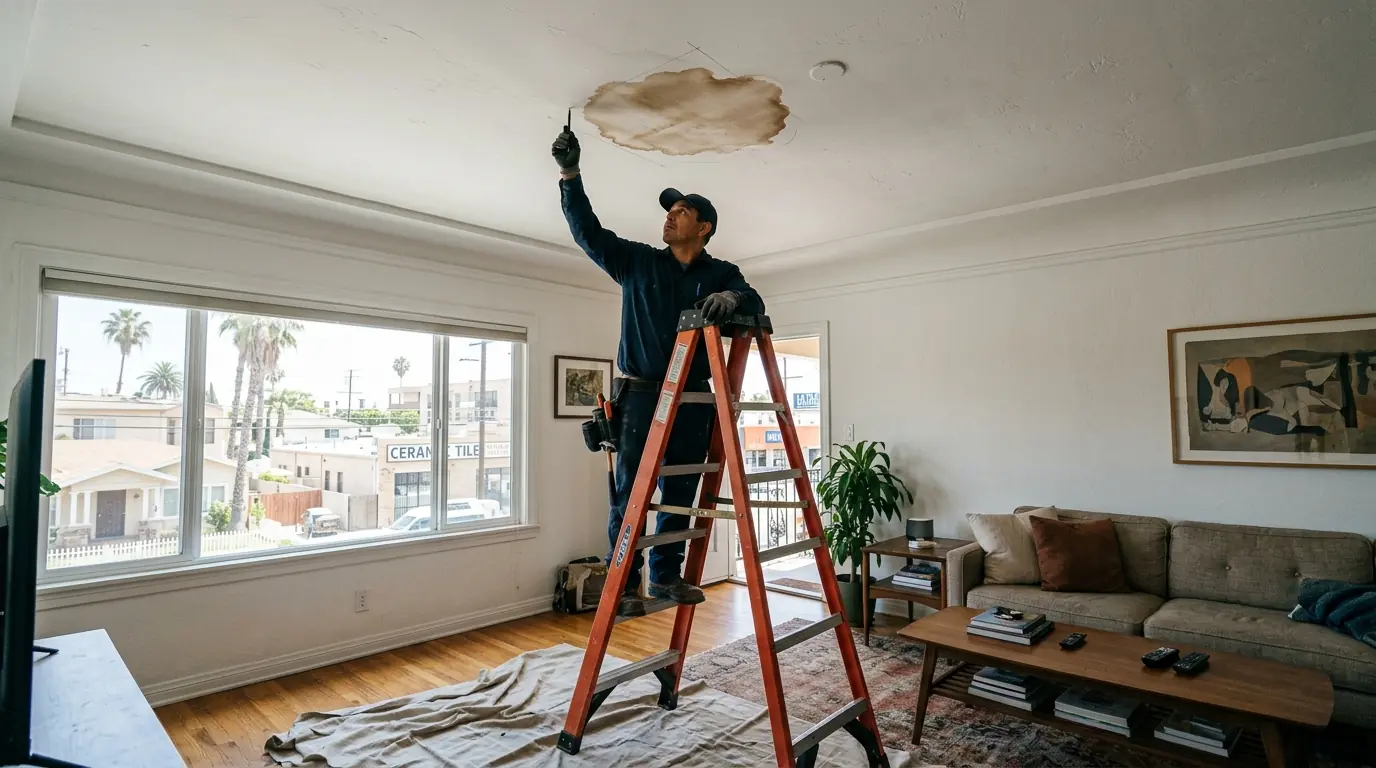
Ceiling or wall stains
Brown rings that grow after rain.
Bubbling paint
Water trapped behind paint or drywall.
Damp attic insulation
Wet or matted insulation under the roof.
A musty smell upstairs
Moisture in the attic or walls.
Drips at light fixtures
Water following wiring to the nearest opening.
Stains near chimneys or skylights
Failed flashing at a roof transition.
Mold on rafters
A slow leak or trapped condensation.
What happens when you call about a leak
Tell us what is happening
An active drip, a stain or a bulging ceiling sets the priority.
Stop the water
Tarp or temporary seal if water is coming in now.
Trace the path
Attic first, then the roof transitions above it.
Repair the source
The failed flashing, boot, valley or seam is fixed properly.
Show you
Photos of the path, the source and the repair.
Where we find leaks, and how we fix them
Ceiling stain leak tracing
We start inside: the stain, the attic above it and the path water took along rafters and decking. Then we go onto the roof above that path and check each transition, water-testing a section when needed. Only when the source is certain do we repair it, and we photograph the path so you can see why. If the stain is dry when we arrive, moisture readings on the drywall and in the attic still show where water has been, so a dry day doesn't stop the search.
Valley leak repair
Valleys carry the most water on any sloped roof, and debris, worn metal or shingles cut too short turn them into leaks. We clear the valley, replace worn metal or membrane, and relay the shingles or tile so water runs down the center instead of under the edges. Closed-cut valleys on shingle roofs are a common weak point when the cut edge was never sealed, so we check that detail even when the valley looks clean from the ground.
Pipe boot and vent leak repair
Rubber pipe boots crack in the sun, and vent flashings loosen or rust. They are common leak sources on LA roofs and among the simplest to fix properly. We replace the boot or flashing with a new unit woven into the roofing, not a smear of tar over the old one. Boots on the sunny slopes crack first, so if one has failed we'll check the others on that side too, since replacing them together saves a second trip up the roof.
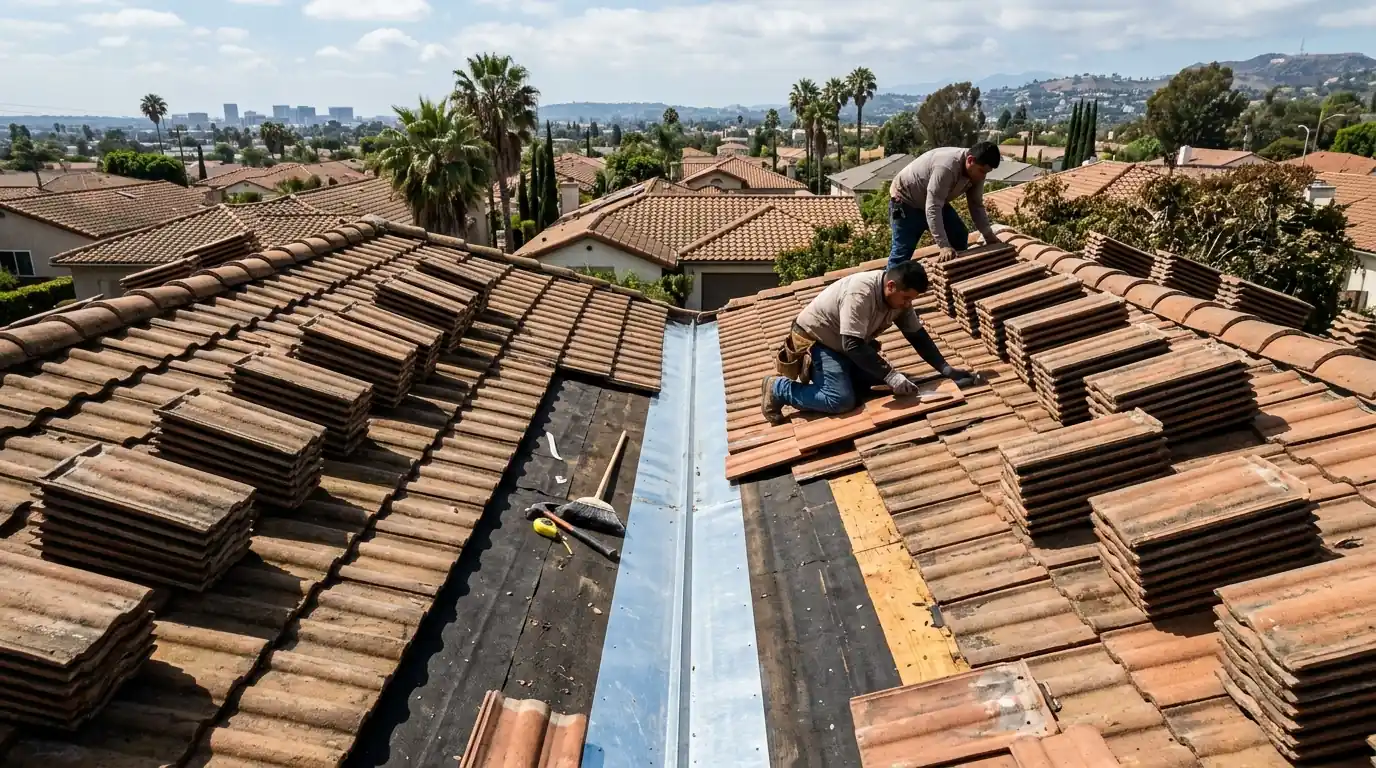
Roughly one third of Los Angeles homes have clay or concrete tile, where leaks come from the underlayment rather than the tile you see, so tracing means lifting tiles along the path. Code also generally allows only one re-cover, and on a roof that already carries two layers, water can run between them for feet before it shows, which is why we check the layer count on every leak call.
What a leak repair costs depends on
Leak repairs are priced once the source is found. Five things set the cost:
- Emergency cover
Tarping or temporary sealing is its own line item.
- Finding the source
Complex paths and water testing take time.
- Where the leak is
A pipe boot is simpler than a valley or chimney.
- Roof type
Tile must be lifted and reset; flat roofs need matching membrane.
- Hidden damage
Wet decking or insulation found during the repair.
What to do before we arrive, and what not to do
Put a bucket under the drip and move furniture and electronics. If a ceiling is bulging with water, poke a small hole at its lowest point so it drains into the bucket, and switch off lights near any wet fixture.
Don't climb onto a wet roof or spread tar over the spot you think is leaking. Wet roofs are slippery, and tar hides the real source.
Roof leak questions
Straight answers to what people ask us most about this job.
Other ways to reach usYes, calls are answered 24/7. Active leaks are covered first; the permanent repair follows once the roof is dry.
Wind-driven or heavy rain reaches gaps light rain misses, often at valleys, walls and skylights.
Usually. Stains, attic evidence and water testing confirm the source in dry weather.
Leaks that show up without rain point to plumbing or AC condensate, and we will tell you if it isn't the roof.
Most are done in one visit once the source is found; tile or valley work can take longer.
Sudden damage is often covered; gradual wear usually isn't. Our photos help your adjuster decide.
If leaks keep appearing in new places, the roof may be done; see when a roof needs replacing.
Other repairs & leaks jobs we handle
Structural Roof Repair in Los Angeles
Structural Roof Repair.
Step and wall flashing
Roof Flashing Repair.
Melted vents, gutters and flashing
Fire and Smoke Damaged Roof Repair.
Slipped tile reset
Tile Roof Repair.
Loose and leaking fasteners
Metal Roof Repair.