Roof decking and dry rot repair for Los Angeles roofs and eaves
The deck is the wood layer every roof is fastened to, and when it rots, nothing above it holds. We replace soft sheathing, repair rotted rafter tails and eaves, and fix the leak or ventilation problem that let the rot start.
- Answered 24/7
- Sheathing by the sheet
- Eaves and rafter tails
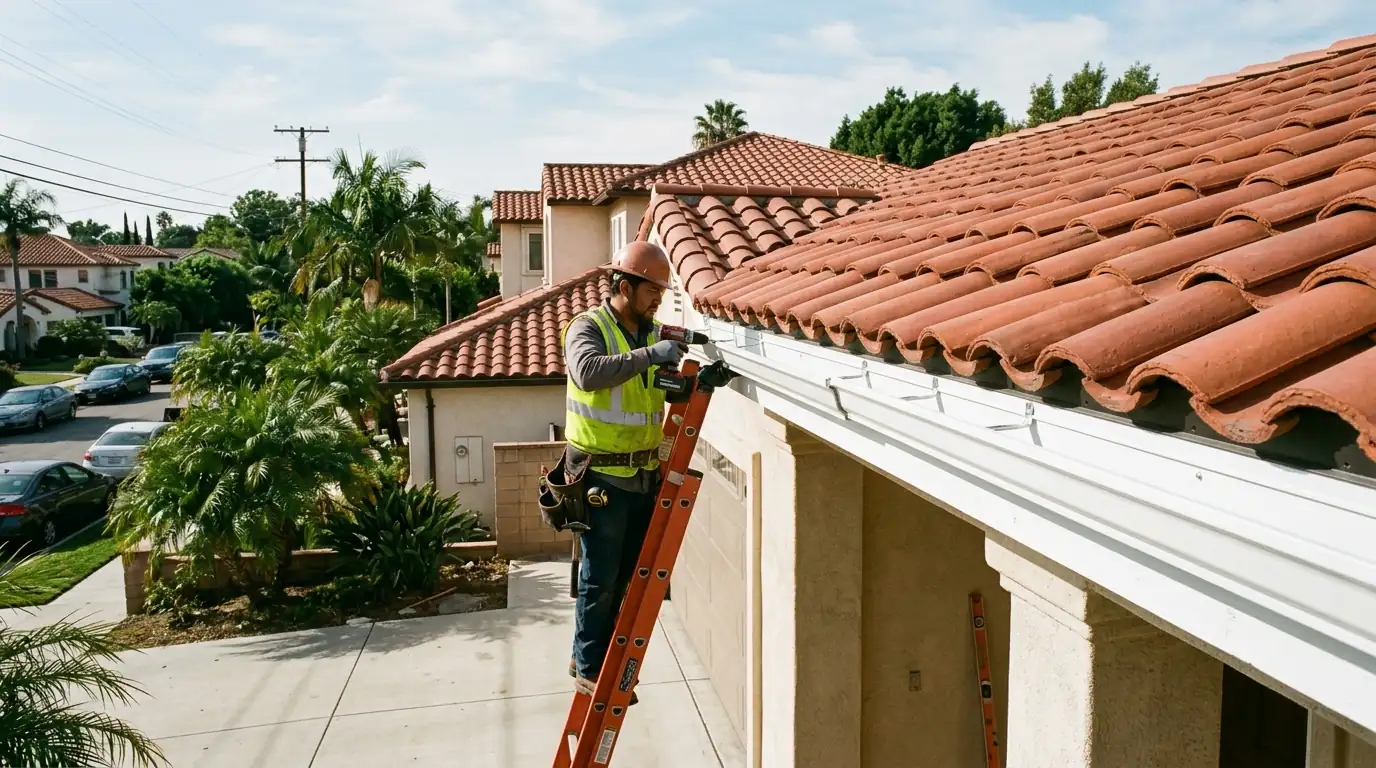
Roof decking and dry rot repair in Los Angeles replaces the wood a roof is fastened to: soft plywood or planks, rotted rafter tails and decayed eaves. We cut every piece of rot back to sound wood, install new sheathing or framing to match, and correct the leak or trapped moisture that caused it.
Updated September 2026
Dry rot is fungus, and it always started with water
Despite the name, dry rot needs moisture to start. A slow leak, a gutter overflowing onto the eave, or an attic with no airflow keeps wood damp long enough for decay fungus to grow. By the time you see crumbling wood or feel a soft spot on the roof, the damage usually runs past what is visible.
Most decking work happens during a roof replacement, when the deck is exposed and rot is priced per sheet. Eave and rafter-tail rot can often be repaired on its own, together with fascia and soffit work along the same edge.
What decking and dry rot repair costs depends on
Rot is priced by what has to come out. Five things set the cost:
- Sheets of decking
Sheathing is priced per sheet replaced.
- Linear feet of edge
Rafter tails, fascia and eave work are priced by length.
- Profile matching
Shaped rafter tails on older homes take more carpentry.
- Roof covering
Tile has to be lifted and reset over repaired areas.
- Moisture source
Fixing the leak or airflow that caused the rot.
Decking, rafter tails and eaves
Plywood sheathing replacement
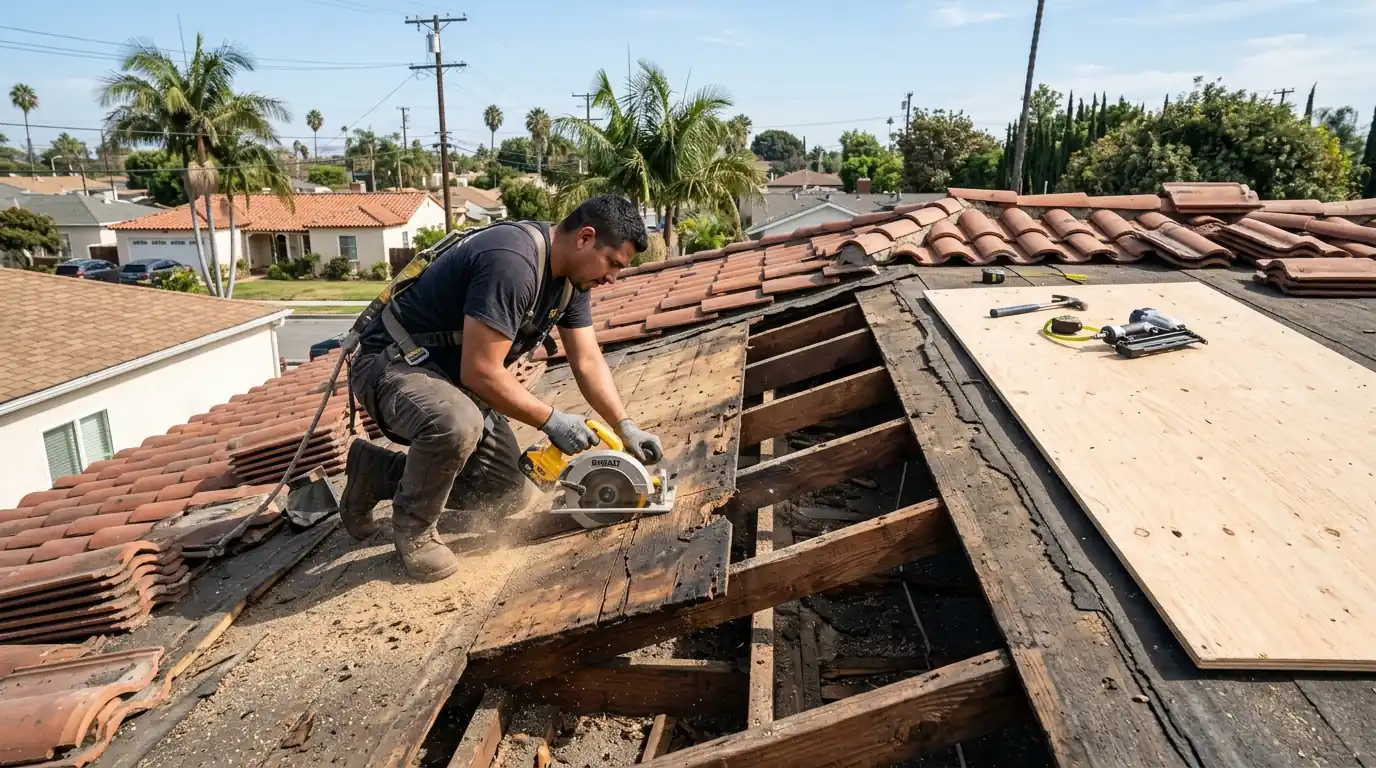
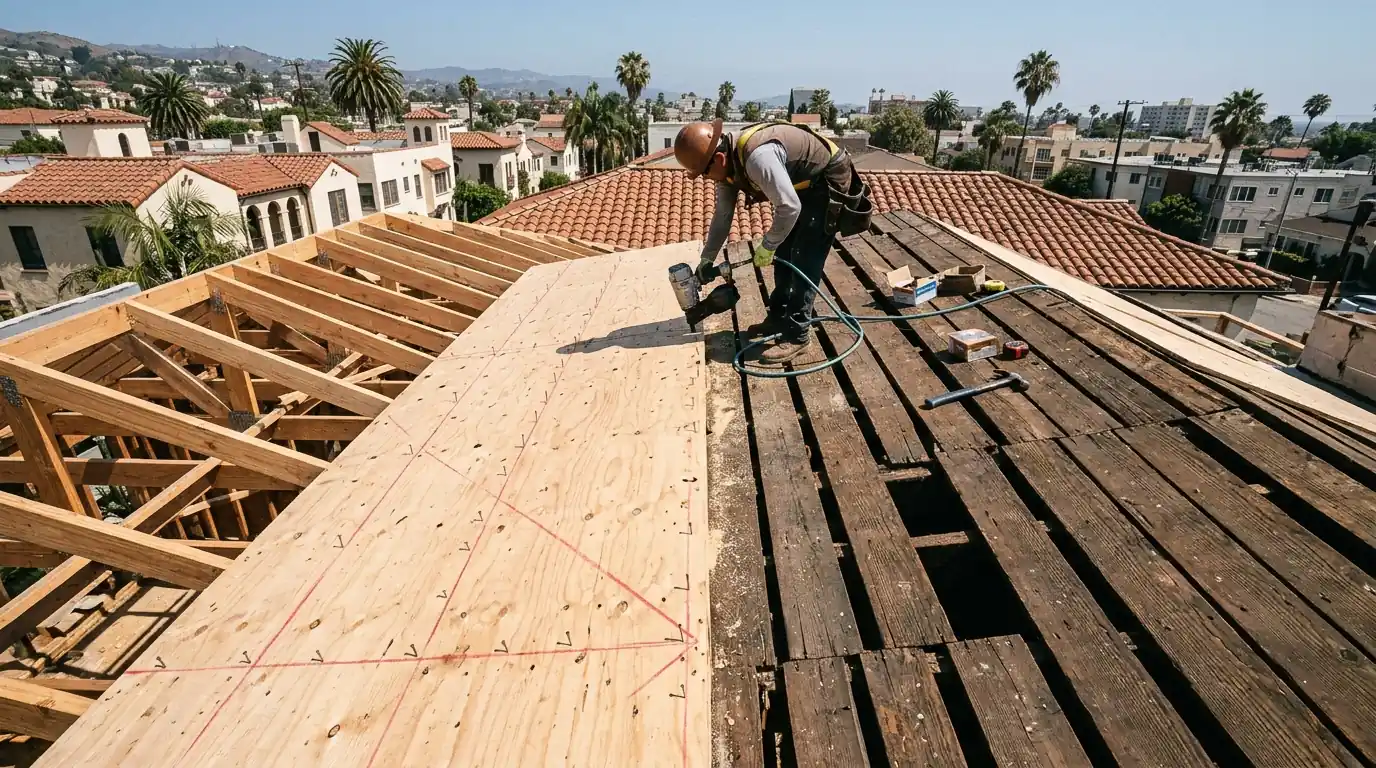
Delaminated or rotted plywood, and old spaced planks that sag between rafters, are cut back to the rafter centers and replaced with sheathing of matching thickness. Joints land on framing, edges are spaced properly, and fasteners follow the schedule, so the new deck is solid under the roofing. On roofs with old spaced boards under tile, we'll check each board, since sound ones can stay and be covered while cracked or rotted ones must be replaced before anything goes on top.
Rafter tail repair
Rafter tails, the ends that stick out past the wall to form the eave, take the most weather and rot first. We cut back the rot, splice new tails onto sound rafters or replace them, and on older homes match the original shaped profile so the eave looks as it should. Tails that carry a gutter or a heavy fascia need extra care, because a splice that looks fine can still sag under a full gutter if it isn't fastened into sound wood.
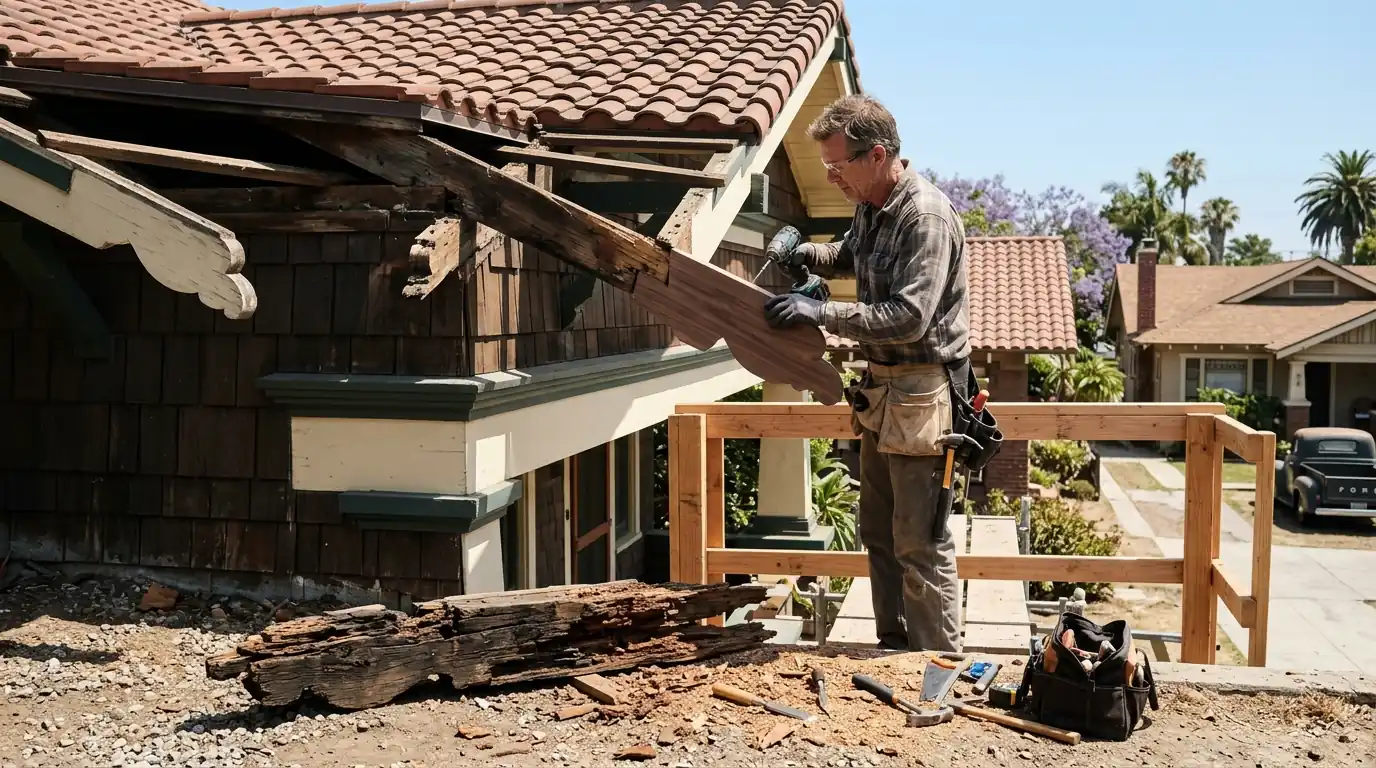
Eave dry rot repair
Eaves rot where gutters overflow, where drip edge was never installed and where paint failed. We open the eave, remove rotted sheathing, fascia and trim, repair the framing, and rebuild the edge with new wood and drip edge so water stops reaching it. We also check the wall below the eave for stains and soft sheathing, since water that rotted the eave often ran down behind the stucco as well and needs to be dealt with at the same time.
What our decking and dry rot repair includes
Rot work is priced and documented the same way every time.
- Probe and photo survey of every suspect area
- Rot cut back to sound wood, not just the soft surface
- New sheathing matched to the existing thickness
- Rafter tails spliced or replaced to the original profile
- Drip edge and flashing restored at the repaired edge
- The leak or moisture source fixed, not just the wood
- Per-sheet and per-foot pricing in the written scope
Most re-roofs in the City of Los Angeles go through an LADBS express permit, and once new sheathing goes on, the job needs two inspections instead of one, so deck work changes the schedule. LADBS roofing permits typically run $250-$1,200, about $370 for a standard home, and we build the extra inspection into the timeline so it never holds up the roof.
How to check for rot without climbing the roof
From the attic, look for dark or stained sheathing, daylight at joints and soft spots when you press with a screwdriver. Outside, press the fascia and rafter tails at corners and under gutters.
Don't walk a roof you suspect is rotten, since soft decking can give way underfoot. Photos from the attic or the ground are enough for us to start.
How a rot repair runs
Probe and map
We find every soft area from the attic and the roof.
Open and cut back
Rot is removed back to sound wood.
Rebuild
New sheathing, tails or eave framing installed to match.
Seal the edge
Drip edge, flashing and roofing restored over the repair.
Fix the cause
The leak, overflow or airflow problem is corrected.
Decking and dry rot questions
Straight answers to what people ask us most about this job.
Other ways to reach usSoft spots underfoot, sagging between rafters, and dark stained wood in the attic are the usual signs.
Small areas can be opened and patched. Widespread rot is best handled during a replacement.
Overflowing gutters, missing drip edge and failed paint keeping the wood damp; properly pitched gutters stop most of it.
No, though they can look alike. If we find termite damage, we point it out so you can have it treated.
Yes. We copy the original profile rather than boxing the eave in.
Sheathing replaced during a re-roof falls under the re-roof permit and adds an inspection.
Not once the moisture source is fixed, which is why we pair rot repair with the leak, gutter or attic ventilation fix.
Other exterior & roofline jobs we handle
Wildfire Roof Hardening in Los Angeles
Wildfire Roof Hardening.
Patio Cover and Carport Roofing in Los Angeles
Patio Cover and Carport Roofing.
Drip edge installation
Fascia and Soffit Repair.
Gutter Installation and Repair in Los Angeles
Gutter Installation and Repair.
Solar tube installation
Skylight Installation and Repair.